This travel plug adapter guide will help you determine exactly which plug shape you need for your destination and whether your device requires a heavy voltage converter. While a passive adapter easily changes the physical shape of your plug, using one on a standard 120V appliance in a 230V socket will instantly ruin your device. Fortunately, most modern laptop and phone chargers are already dual-voltage, meaning you likely just need a cheap adapter to get connected.
Quick answer
- Check your voltage: Look for “INPUT: 100-240V” on your device’s power brick; if it has this, you only need an adapter.
- Check the shape: Identify your destination’s plug letter (e.g., Type C for most of Europe).
- Warning: Single-voltage items like hair styling tools require an active voltage converter, not just a passive adapter.
Adapter vs. Converter: What is the Difference?
When preparing for an international trip, the most critical distinction to understand is the difference between an adapter and a converter. An adapter is a passive device that simply changes the physical shape of your prongs so they fit into a foreign wall socket. It does not alter the electrical current or voltage in any way. A converter, on the other hand, is an active electrical device that steps down the voltage from the wall to match what your appliance expects.
If you are already buying a portable charger for a long flight, knowing exactly how to safely plug it into the wall once you land is the critical next step. Plugging a single-voltage device into a foreign outlet using only an adapter can cause immediate permanent damage, trip circuit breakers, or start a fire. Identifying whether your gear requires a simple shape change or a complete electrical conversion is the foundation of travel safety.
Step 1: How to Check Your Charger’s Voltage
Before buying any travel accessories, you must check the microscopic text printed directly on your power bricks and charging cables. Look for a specification line that begins with “INPUT”. If the text reads “INPUT: 100-240V ~ 50/60Hz”, your device is dual-voltage. This means it features a built-in switching mechanism that automatically handles the 120V electrical standard used in North America, as well as the 220V to 240V standards used across most of Europe, Asia, and Africa.
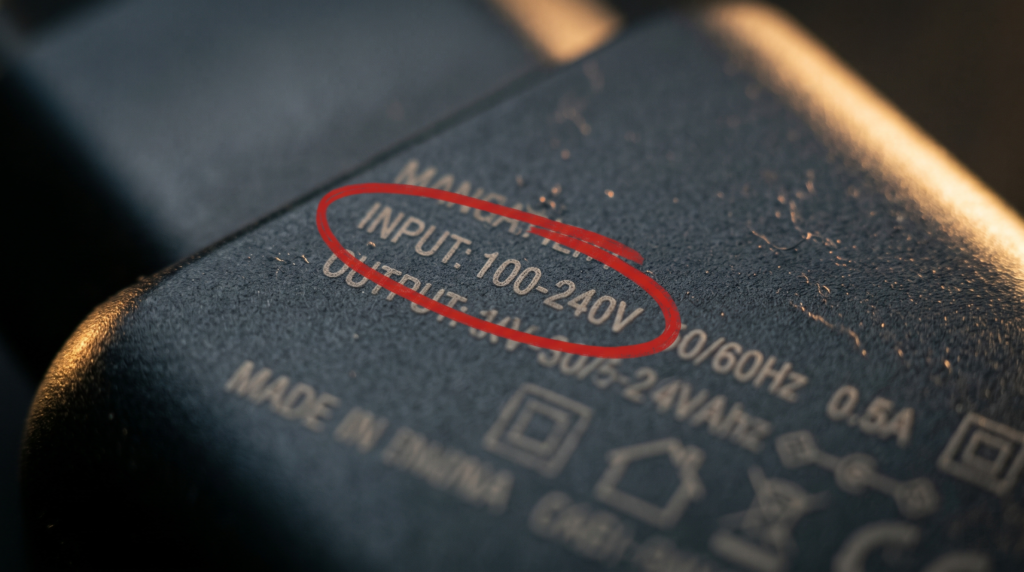
Locating this text can sometimes be challenging. On laptop power bricks, the input information is usually printed on the bottom flat surface of the rectangular block. For compact smartphone chargers, such as standard Apple or Samsung cubes, the text is frequently stamped lightly on the bottom face, right between the two metal prongs. Because the text is often molded in the same color as the plastic with very low contrast, using your smartphone camera to zoom in and read the specifications is a highly effective diagnostic trick.
Most modern laptop chargers, smartphone power adapters, camera battery docks, and GaN (Gallium Nitride) charging blocks are manufactured as dual-voltage devices. Because these electronics regulate their own internal power delivery, they do not require a heavy, expensive voltage converter. You only need a simple, passive plug adapter to physically connect them to the wall socket at your international destination. However, always verify the input label on every individual device you plan to pack rather than assuming compatibility.
Step 2: Find Your Destination’s Plug Type
There are 15 standardized plug shapes used worldwide, designated by the letters A through O. Finding the correct letter for your destination is the second crucial step in building your travel kit. Once you identify the right adapter shape, you can neatly store charging cables in your luggage alongside the plug to keep your travel kit organized and ready for deployment.
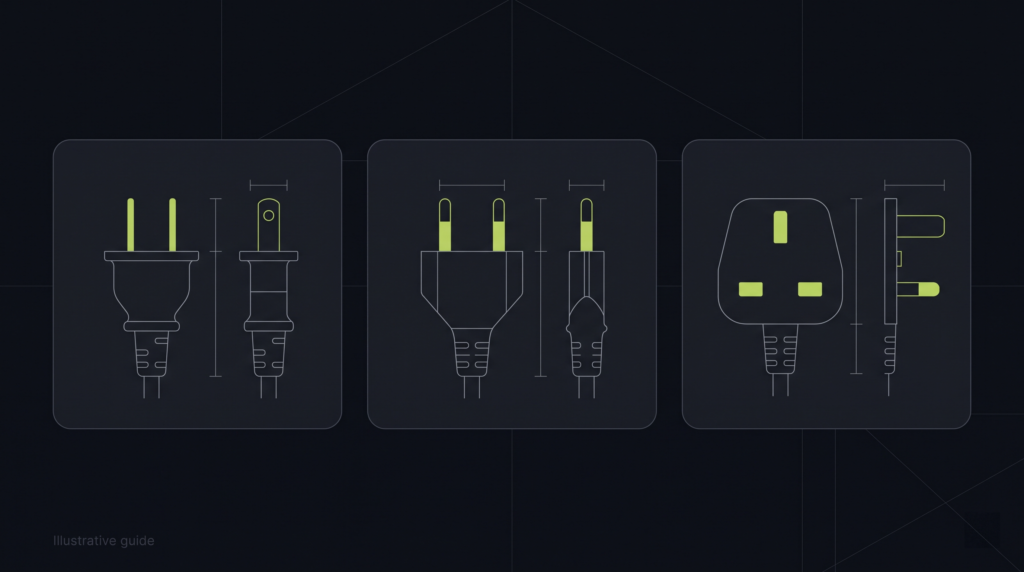
For travelers leaving North America, the most common requirements are Type C for continental Europe and Type G for the United Kingdom. Type C features two round pins and is widely accepted across many European, South American, and Asian countries. It is typically ungrounded and is designed for low-power devices like phone chargers. Type G uses three thick rectangular pins arranged in a triangle, features an internal fuse for safety, and is standard in the UK, Ireland, Singapore, and the UAE. Meanwhile, when traveling to Japan, you might encounter sockets designed strictly for Type A (two flat parallel pins). If your US laptop charger uses a Type B plug (which adds a round grounding pin), you will still need an adapter to fit the ungrounded Japanese outlets.
| Destination Region | Primary Plug Type | Standard Voltage | Needs Converter (from US 120V)? |
|---|---|---|---|
| United Kingdom & Ireland | Type G | 230V | Yes, for single-voltage devices only |
| Continental Europe | Type C / E / F | 230V | Yes, for single-voltage devices only |
| Japan | Type A / B | 100V | No (120V devices function normally on 100V) |
| United States & Canada | Type A / B | 120V | Baseline (No converter needed) |
Warning: Hair Styling Tools and Single-Voltage Devices
High-wattage appliances that generate heat, such as hair dryers, curling irons, and straighteners, are rarely dual-voltage. These devices are typically built as single-voltage items designed exclusively for a 120V grid. If you take a US hair dryer to Europe and plug it into a 230V socket using only a physical adapter, the device will receive nearly double the expected voltage. This will cause the internal heating elements to overheat instantly, trip the circuit breaker, or catch fire.
For these specific items, you must use a heavy-duty step-down voltage converter rated for high wattage, which can be bulky and expensive. Often, a more practical solution is to simply purchase a dual-voltage travel hair dryer explicitly designed for international use. Never assume an appliance is safe to plug in just because the physical pins happen to fit inside a plastic travel adapter.
Before packing your bags, double-check the fine print on your most critical devices—especially hair styling tools—to confirm they explicitly say “100-240V” so you can safely use a standard plug adapter abroad without a heavy converter.
Sources
Last reviewed: November 12, 2026