When deciding between magsafe vs qi2, the main difference is that MagSafe is Apple’s proprietary standard, while Qi2 is a universal magnetic charging standard that delivers the same 15W speeds to both supported iPhones and Androids. However, just because a phone supports Qi2 charging speeds does not mean it will magnetically attach out of the box. For example, major devices like the Samsung Galaxy S25 and S26 require a specialized magnetic case to stick to Qi2 charging stands, catching many buyers off guard.
Quick answer
- Qi2 chargers offer MagSafe-like 15W performance universally, but many new Android phones require a magnetic case to attach to them.
- Source: Official WPC Qi2 specification
- Check your phone’s built-in magnet status before buying a desktop stand or car mount.
What is the Real Difference Between MagSafe, Qi2, and Qi2.2?
For years, wireless charging was fragmented. Apple users enjoyed the convenience of the proprietary MagSafe ecosystem, which combined reliable 15W charging speeds with a ring of magnets for perfect alignment. Meanwhile, Android users were largely left with the older, slower Qi standard, which relied entirely on gravity and precise manual placement to work correctly.
This changed when the Wireless Power Consortium (WPC) introduced the Qi2 standard. Built directly upon the foundation of Apple’s Magnetic Power Profile, Qi2 was designed to unify the wireless charging landscape. The core advantage of a standard Qi2 charger is that it can deliver up to 15W of power to both supported iPhones and compatible Android devices, eliminating the brand lock-in that previously defined magnetic charging.
However, mixing these ecosystems without understanding their limits can result in severely throttled charging speeds. For instance, if you place a standard Android phone on an official Apple MagSafe charger, the charger will default to a basic Qi profile, trickling power at much slower standard speeds rather than the 15W maximum. Whether you are buying a desktop stand or deciding on a portable charger, understanding these limits is essential.
More recently, the landscape has shifted again with the introduction of Qi2.2. While the original Qi2 standard capped wireless charging at 15W, the updated Qi2.2 specification pushes this limit to 25W. This upgrade allows newer wireless chargers to rival entry-level wired charging speeds, provided that the smartphone’s internal hardware and the power adapter plugged into the wall both support the higher wattage output.
Phone Family × Standard Compatibility Matrix
Use the matrix below to determine how your specific smartphone family interacts with the major wireless charging standards. Pay close attention to the built-in magnet status, as this dictates whether your device will physically stick to the charger or simply slide off.
| Phone Family | MagSafe Charger (Max Speed) | Qi2 Charger (Max Speed) | Built-in Magnets? | Magnetic Case Required? |
|---|---|---|---|---|
| iPhones (12 and newer) | Yes (15W to 25W depending on model) | Yes (15W universally) | Yes | No |
| Samsung Galaxy S25 / S26 | No (Defaults to slow standard Qi speeds) | Yes (Supports 15W/25W Qi2 logic) | No | Yes, strictly required for vertical mounts. |
| Older Androids (Standard Qi) | No (Slow standard Qi speeds only) | No (Slow standard Qi speeds only) | No | Yes, but charging will still be slow. |
Do Samsung and Other Android Phones Need a Special Case?
One of the most confusing aspects of the new charging landscape is the distinction between supporting a charging speed profile and actually having the physical hardware to utilize magnetic mounts. A phone can be officially rated to support Qi2 power delivery without including a single magnet inside its chassis.
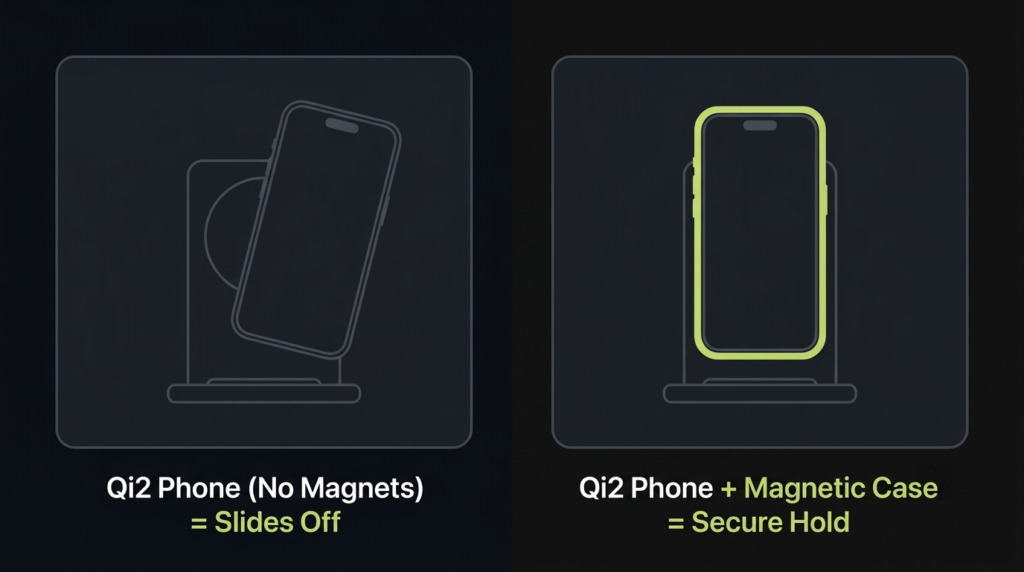
This exact scenario occurred with the release of the Samsung Galaxy S25 and S26 series. While these devices are technically capable of receiving Qi2 and Qi2.2 charging speeds, Samsung chose to omit the internal magnetic ring. Consequently, if an S26 owner attempts to place their bare phone onto an angled desktop Qi2 stand or a magnetic car mount, the device will immediately slide off.
To solve this, Samsung users must purchase a third-party magnetic case that features an embedded metal or magnetic ring. This case serves two critical functions. First, it physically secures the device to the charger, allowing for vertical and angled mounting. Second, it ensures that the charging coils inside the phone and the charger align perfectly. Poor alignment is the leading cause of excess heat generation during wireless charging, which prompts the charger to throttle speeds to prevent battery damage. Before you buy your next charging stand or build your everyday phone accessory kit, confirm exactly what your phone model supports natively.
For more detailed technical specifications regarding magnetic power profiles and device compatibility, refer to the Wireless Power Consortium (WPC) official Qi specification and the Apple MagSafe support documentation.
Before purchasing your new wireless setup, always verify the thickness of your chosen phone case, as anything thicker than 3mm can severely disrupt the magnetic alignment and charging speeds of both MagSafe and Qi2 systems.
Sources
- Wireless Power Consortium (WPC) — Qi2 and Qi2.2 Specification Press Releases
- Apple Support — How to use your MagSafe Charger with iPhone models
- Samsung Electronics — Galaxy S25 and S26 Series Technical Specifications
Last reviewed: November 4, 2026