Understanding the exact mah to wh power bank airline limit comes down to one international standard: portable chargers rated up to 100 Watt-hours (Wh) are permitted in carry-on baggage without prior airline approval. A hidden voltage trap exists, however. While many travelers assume any battery marketed near 27,000mAh is automatically flight-safe, models built with modern 3.8V cells actually output 102.6Wh—crossing directly into the restricted tier that requires explicit airline permission. Converting your charger’s milliamp-hours using its internal nominal voltage ensures your gear complies with TSA and 2026 IATA carry-on mandates before you reach airport security.
Quick answer
- Baseline Limit: Power banks up to 100Wh are permitted in carry-on baggage without prior approval.
- The Formula: Watt-hours (Wh) = (mAh ÷ 1,000) × Nominal Cell Voltage (V).
- Core Flight Rules: Carry-on bags only (never checked luggage), max two units per passenger (IATA 2026), and no in-flight recharging.
- Verification: Security screeners require a legible, factory-printed Wh or mAh rating on the physical casing to permit boarding.
The mAh to Wh Conversion Formula: How to Calculate Your Power Bank’s Rating
Aviation authorities strictly regulate lithium-ion batteries by their energy capacity, which is measured in Watt-hours (Wh). However, manufacturers almost exclusively market power banks using milliamp-hours (mAh). To bridge this gap, you must manually calculate the Watt-hour rating before packing your bag. The formula is straightforward: divide the mAh by 1,000, and multiply the result by the battery’s nominal cell voltage. For example, a 20,000mAh battery using standard 3.7V cells equals exactly 74Wh.
The most critical error travelers make during this calculation is using the wrong voltage multiplier. Many modern power banks prominently display a “5V” or “9V” USB output specification on the packaging or near the charging ports. This is the output delivery voltage, not the internal battery chemistry voltage. Calculating a 20,000mAh battery using a 5V USB output results in a false 100Wh rating, making the battery appear dangerously close to the limit. You must always use the internal nominal cell voltage—typically 3.6V, 3.7V, or 3.8V for lithium-ion and lithium-polymer cells—to get the legal and accurate energy measurement.
Understanding this mathematical distinction is especially vital for business travelers, digital nomads, and frequent flyers. Working remotely or running heavy-duty electronics on a long-haul flight requires massive backup power, driving travelers to purchase the largest batteries available. Relying on the marketing number on the front of the box is not enough when navigating TSA checkpoints. If you are also confused by the various charging cables you need to pack for these high-capacity devices, understanding USB-C connectors, cables, and charging protocols ensures you bring the right gear for your devices without adding unnecessary weight to your personal item.
The Tri-Voltage Aviation Compatibility Matrix (10,000mAh to 30,000mAh)
Global aviation regulations divide lithium-ion power banks into three distinct tiers: under 100Wh (no airline approval required), 101Wh to 160Wh (airline approval required), and over 160Wh (strictly banned on passenger aircraft). While smaller 10,000mAh and 20,000mAh power banks safely pass the 100Wh baseline regardless of their internal chemistry, the threshold becomes heavily contested when dealing with ultra-high-capacity power banks marketed between 26,800mAh and 30,000mAh.
This is where the “voltage trap” catches many travelers off guard. Historically, lithium-ion cells operated at a nominal voltage of 3.6V or 3.7V. A 27,000mAh power bank operating at 3.7V calculates to 99.9Wh, passing just under the 100Wh legal limit for hassle-free carry-on travel. However, battery technology has advanced, and many premium, high-density power banks now utilize 3.8V internal cells. That exact same 27,000mAh capacity multiplied by 3.8V results in 102.6Wh. Because it crosses the 100Wh line, it legally requires explicit permission from the airline prior to boarding, and security screeners have the full authority to deny it at the checkpoint.
The matrix below highlights these tipping points across the three most common internal cell voltages. When replacing an oversized or illegible battery that fails this math, consult a comprehensive portable charger buying guide to find a travel-friendly model that fits airline constraints perfectly while still delivering the power you need.
| Capacity (mAh) | Nominal Voltage | Calculated Energy (Wh) | Compliance Tier & Condition |
|---|---|---|---|
| 10,000mAh | 3.7V | 37.0Wh | ≤100Wh (Allowed in carry-on) |
| 20,000mAh | 3.7V | 74.0Wh | ≤100Wh (Allowed in carry-on) |
| 26,800mAh | 3.6V | 96.4Wh | ≤100Wh (Allowed in carry-on) |
| 27,000mAh | 3.7V | 99.9Wh | ≤100Wh (Allowed in carry-on) |
| 27,000mAh | 3.8V | 102.6Wh | 101-160Wh (Airline approval required) |
| 30,000mAh | 3.7V | 111.0Wh | 101-160Wh (Airline approval required) |
| >43,200mAh | 3.7V | >160.0Wh | Banned on passenger aircraft |
Airline Power Bank Limits and 2026 Flight Regulations
Calculating the correct Watt-hour rating is only the first half of the travel compliance equation. Both the Federal Aviation Administration (FAA) and the International Air Transport Association (IATA) enforce strict physical rules about how and where these backup batteries can be transported. The most fundamental rule worldwide is the absolute ban on power banks in checked luggage. Because lithium-ion batteries carry a risk of thermal runaway, they must be kept in the pressurized, accessible cabin environment where flight attendants can immediately address any overheating issues. If a power bank is discovered in your checked suitcase during automated baggage screening, it will be confiscated, and your luggage may be delayed.
Recent 2026 IATA guidance has introduced new restrictions that affect quantity and usage. Globally, travelers are now limited to a maximum of two power banks per person, regardless of how small they are. Domestic policies can be even stricter; for example, Southwest Airlines currently limits passengers to exactly one power bank per person. Additionally, 2026 IATA rules strictly prohibit the in-flight recharging of the power bank itself. While you can use the portable charger to power your phone or tablet during the flight, plugging the actual power bank into the aircraft’s AC outlet or USB port to recharge its internal cells is banned.
Preparing a compliant everyday carry (EDC) loadout eliminates the stress of packing for both daily transit and international trips. Integrating a compliant power bank into your daily commuter accessories setup means you are always ready for both local transit and international flights without having to swap gear at the last minute or worry about confiscation at the airport.
| Regulatory Factor | Global Baseline Rule | Required Traveler Action |
|---|---|---|
| Carry-On Baggage | Permitted (Requires approval if over 100Wh) | Pack in personal item or carry-on backpack. |
| Checked Baggage | Strictly Banned | Never place in a suitcase bound for the cargo hold. |
| Maximum Quantity | Maximum 2 units per person (IATA 2026) | Limit your gear; check specific airlines (e.g., Southwest limits to 1). |
| In-Flight Recharging | Banned (IATA 2026) | Do not plug the power bank into aircraft outlets. |
| Casing Labeling | Must be clearly legible | Inspect the fine print before departure to ensure it has not rubbed off. |
How to Verify Your Power Bank’s Label Before Airport Security
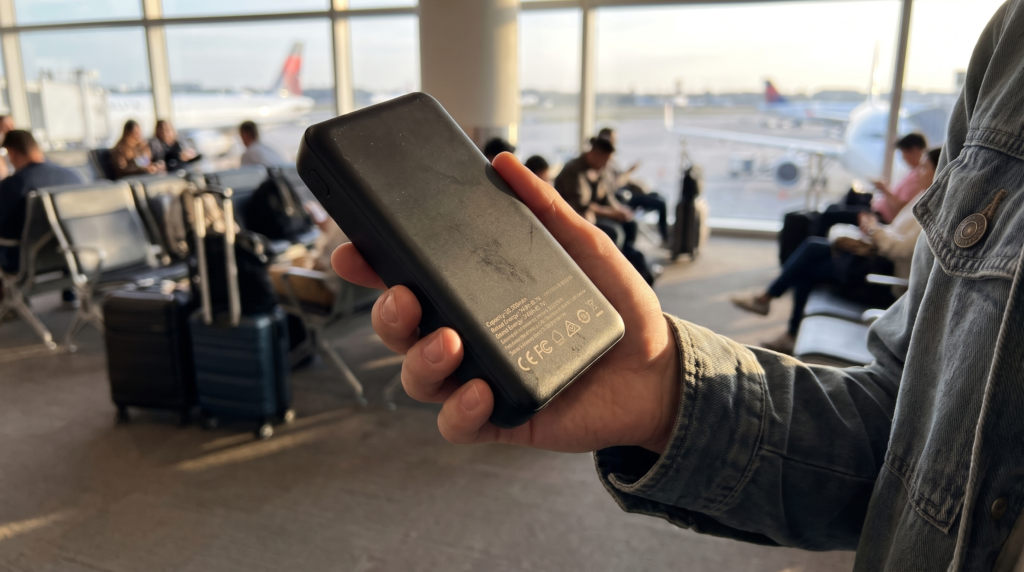
The final and most commonly overlooked checkpoint hurdle has nothing to do with the actual size or chemistry of your power bank, but rather the physical condition of its casing. All aviation authorities require the battery’s energy rating—either the calculated Watt-hours (Wh) or the milliamp-hours (mAh) paired with the voltage (V)—to be visibly and permanently printed on the external shell. If this text is illegible, security screeners are required to assume the device exceeds the 160Wh maximum limit.
Because portable chargers spend years rattling around in backpacks alongside keys, laptops, and hard cases, the fine print printed on the bottom or back panel frequently rubs off. A perfectly legal 5,000mAh battery will be immediately confiscated by TSA agents if they cannot read the capacity label to verify its safety. Screeners do not have the time or the tools to plug in your device, weigh it, or look up the model number online; their decision is strictly limited to what is printed on the hardware.
Take a moment to inspect the bottom edge or rear panel of your portable charger under bright light. You are looking for a small block of laser-etched or painted text. Locate the line that lists “Capacity” or “Rated Energy.” If the Wh rating is explicitly printed, you do not need to do any math—simply ensure that number is 100Wh or less. If the text only shows mAh and V, confirm that the printing is crisp and clear enough for a security officer to read at a glance. If the label is severely faded, scratched, or covered by unremovable adhesive, the power bank is no longer flight-safe and must be left at home.
Before departing for the airport, confirm that the capacity markings on your battery casing are completely legible and place the unit inside your carry-on luggage, as worn-off print or placement in checked baggage will result in immediate security confiscation.
Sources:
- Belkin: TSA Approved Power Bank Travel Guide
- Trip.com: Portable Charger Flight Guidelines
- Tripbuffer: 2026 IATA Power Bank Updates
- PowerBankOnAPlane: Aviation Battery Limitations
Last reviewed: November 8, 2026